Sarah
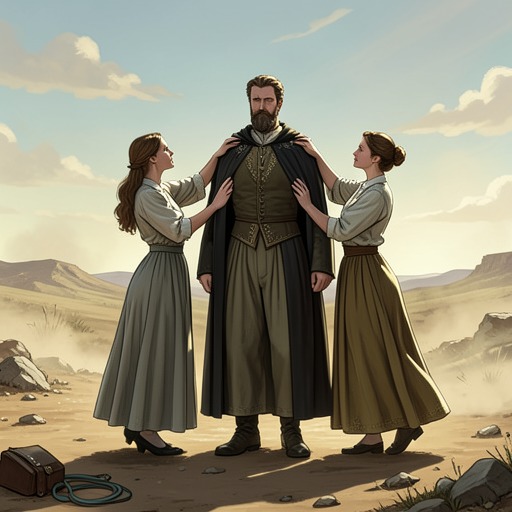
Chasing SunlightSarah is Eleanor McAvey’s small, dark-haired maid, but the appearance of ordinary domestic service conceals a trained and dangerous field operative. She is introduced as one of two impeccably groomed attendants whose presentation fits a noblewoman’s household while their presence carries an unmistakable aura of lethal capability. Her partnership with Marie gives Eleanor a compact security detail that can pass unnoticed in public, yet respond with professional violence when the expedition turns hostile.
Identity and Position
Sarah’s social role is deliberately misleading. She and Marie look like maids rather than guards, and their faces are described as nearly forgettable, allowing them to disappear into the background of Eleanor’s retinue. Their names are exchanged with Antomine’s guards in a moment of matching introductions: Antomine identifies John and James, while Eleanor identifies Marie and Sarah. The resemblance between the pairs, including the guards’ lack of visible distinction, establishes a world in which service personnel are also instruments of protection and surveillance.
Sarah’s loyalty is primarily attached to Eleanor, whose instructions she follows without hesitation, but her conduct is not passive. When Eleanor orders the quarters secured, Sarah checks the rooms and reports that they remain untouched. The brief report is operational rather than ceremonial: Eleanor is concerned that someone may have entered, and Sarah supplies the information needed to determine whether the ship has been compromised. Her competence therefore begins in the supposedly minor tasks of household management and expands naturally into expedition security.
The Expedition and Its Dangers
Sarah’s first major test comes during the attack on the Endeavor. When Marie is wounded amid burning weaponized zint, Sarah uses a shield improvised from spare piping to protect her from incoming zint-gun fire. Eleanor moves through the shadows to continue the fight, while Sarah remains beside the injured attendant, converting whatever material is available into immediate defense. The scene defines her as both combatant and caretaker: she does not abandon the vulnerable member of the group, and she does not require specialized equipment before acting.
The ship’s instability places Sarah in danger even when no enemy is visible. During the descent from the Endeavor in a gale, Jonathan carries Marie down while Eleanor and Sarah cling to the handholds behind him as an airman lowers them by pulley. Sarah’s role is thus tied to the physical survival of Eleanor’s household, not merely to combat. Later, after Marie receives medication recovered in Autochthon Reach, both maids are able to join the excursion, showing that Sarah’s participation depends on the condition of the whole retinue rather than on an isolated individual mission.
At the boundary between the human settlement and the darker portion of the plateau, Sarah reacts more openly than the others to the unnatural atmosphere of the abhuman buildings. Antomine’s guards remain expressionless, but Sarah hunches under the pressure of the place, while the altered human inhabitants and nonhuman denizens make the border’s influence visible. Her reaction gives the reader a human measure of the environment’s threat. She is trained enough to continue, but not so hardened that the setting loses its power to disturb her.
Combat, Tracking, and Survival
Sarah also demonstrates alertness under pressure. When she suddenly warns of movement to starboard, Jonathan turns toward shadows crawling down a nearby stone tower, and his shots join those of James and John. Her warning enables the defense before the attackers reach the ship. The attack is not presented as a formal command by Sarah; its importance lies in the speed with which she notices danger and converts observation into collective action.
During the rough handling of the Endeavor, Sarah and Marie are both ruffled, while Antomine’s masked guards appear unaffected. The contrast does not make Sarah incompetent. Instead, it distinguishes her embodied vulnerability from the guards’ deliberately unreadable discipline. Sarah can be frightened or physically shaken and still remain useful, armed, and attentive. Her effectiveness is not based on emotional blankness.
Eleanor explicitly trusts Sarah and Marie with urban tracking, arguing that wilderness would pose difficulties but a city should be easy for them. When the group searches for a saboteur, the two maids lead with zint lanterns, apparently following a trail across bare stone without closely examining the ground. Jonathan recognizes their method as one of the unusual skills associated with the Reflected Council, which collects people with extraordinary abilities. Sarah’s expertise therefore extends beyond ordinary reconnaissance: it is mysterious even to the expedition’s experienced leader, and it links her to the hidden networks that have shaped Eleanor’s capabilities.
Relationship with Eleanor and Marie
Sarah’s relationship with Eleanor combines obedience, protection, and intimate knowledge of danger. She checks Eleanor’s rooms, accompanies her through hostile territory, guards Marie, and remains near her mistress when the group faces supernatural pressure. Yet Sarah is also able to read Eleanor’s condition. When Eleanor’s bloodthirst becomes so intense that it rolls ahead of her like a crimson tide, Sarah sees Jonathan and Eleanor approaching her cabin and retreats without speaking. The withdrawal is a survival decision: Antomine is absent, and Jonathan believes that physical resistance by Antomine or the Lux Guard would risk provoking an attack.
Her conduct around Marie is more openly caretaking. After the supernatural presence overwhelms the group and both maids faint, Sarah later answers while coughing and covering her mouth with a sleeve, then takes a long breath before asking about Marie. The action records both her recovery and her immediate concern for her companion. In another crisis, Antomine produces a pistol and directs Sarah to examine Eleanor; Sarah approaches despite giving Jonathan as wide a berth as possible, helps Eleanor sit upright, inspects her condition, and eases her onto the bed. Eleanor is uncomfortable but not dying, and Sarah’s intervention helps establish the immediate consequences of Jonathan’s restraint.
Sarah and Marie also function as a paired social mask. In Ukari’s presence, both retreat into their maid personas, standing demurely and silently behind Eleanor in the hope of avoiding attention from She-Who-Must-Be-Obeyed. Outside the palace, however, they ready their pistols and move beside Jonathan. When airborne creatures attack them in the streets, their visible strain and fear mark them as vulnerable outsiders, but their weapons and readiness show that the domestic performance has not erased their operational identity.
Change, Continuity, and Narrative Role
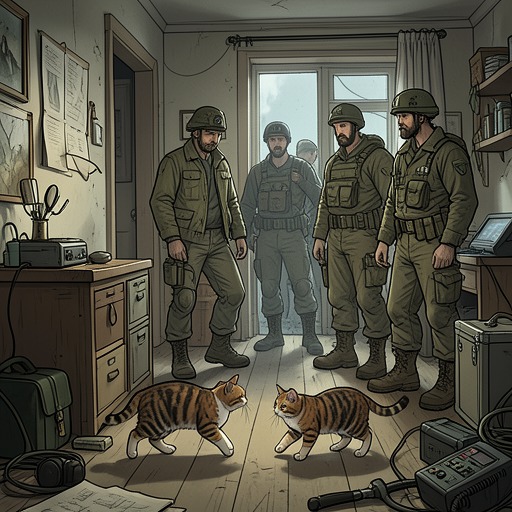
Sarah’s status changes by the end of the account. After the return of the Endeavor and the discovery of Dreyfus, the ship cat from the Discovery, Dreyfus immediately finds a friend in Sarah and jumps into her arms. She asks where he came from, and Jonathan explains that Dreyfus is the Discovery’s ship cat and that no one knows how he survived the intervening years. Sarah accepts the uncertainty and turns back toward the upper decks to care for him. Her response gives the damaged expedition a small, guarded moment of consolation, connecting her habitual caretaking to an unexpected survivor from an earlier disaster.
The final departure places Sarah and Marie visibly within Eleanor’s continuing orbit. They no longer present themselves as maids, although they remain with Eleanor, and each carries a cat over one shoulder: Dreyfus with Sarah and Penelope with Marie. The image preserves their bond with Eleanor while altering the terms of their public identity. Sarah is still a protector and attendant, but the abandoned disguise has become unnecessary, or at least no longer fully defines her.
Sarah’s narrative importance lies in the tension between concealment and exposure. She is introduced as forgettable, yet repeatedly becomes the person who shields the wounded, detects attackers, tracks the missing, assesses Eleanor’s injuries, and receives one of the expedition’s improbable survivors. Her fear in the abhuman quarter, her retreat from Eleanor’s bloodlust, and her guarded optimism after Dreyfus’s return prevent her from becoming a faceless action figure. Sarah represents the practical labor that allows grand expeditions and occult confrontations to continue: someone must secure rooms, carry weapons, follow a trail, protect a companion, and care for what remains alive after the spectacle has ended.